Would be nice to add a “how to use” section in the readme?
Excited to see how this pans out for some of my Purescript projects that are (unfortunately) built for Node/npm ecosystem.
Would be nice to add a “how to use” section in the readme?
Excited to see how this pans out for some of my Purescript projects that are (unfortunately) built for Node/npm ecosystem.
Absolutely! I plan to add that today.
News #1:
Milestone yesterday: 100% of the official PureScript tests are now passing on gopurs! 
The compiler is formally complete and generates reliable Go code.
However, after pushing the current architecture to its limits (the flat Value struct does wonders for the GC) and multiple micro-optimizations, I’ve hit a ceiling. Performance is good, but it’s not yet the raw, blazing speed Go is natively capable of. My stress-tests actually show better results with V8 right now.
Why the ceiling?
gopurs relies on a highly optimized AST that is very close to CoreFn. Unfortunately, CoreFn strips away crucial static typing information. It’s made for JIT runtimes, less for AOT ones. This forces the Go backend to rely on generic, dynamic structures instead of native, strictly typed Go constructs (e.g., using a universal Value struct instead of raw Go ints or unboxed structs). Even if Value gives better results than any, and is as fast as idiomatic Go for simple algorithms, that still is insufficient for complex ones.
The next step: The TAST fork
To break this ceiling and reach a new standard of performance, the next logical move is to explore a TAST (Typed Abstract Syntax Tree) fork. By partially intercepting the fully typed AST before it loses information in the CoreFn conversion, gopurs will be able to generate highly idiomatic, statically typed Go code end-to-end, eliminating residual boxing.
The fork builds successfully, and I’m already working with enriched corefn.json files right now. By simply keeping primitives (int, float, bool, etc.) as they are instead of boxing them into a Value, I’ve already seen a 40% performance gain. And new opportunities are expected to emerge for further optimization.
Stay tuned.
Note: as suggested by @druchan, a complete “How to use” section will be added to the README.md of gopurs, once mature.
News #2:
Victory! 
That’s fantastic.
The TAST approach has more than paid off: that’s a big x10 in perfs. So much so that I’ll soon be submitting a PR to add tcorefn (= corefn JSON + dataDecls array at the root + ann.type on each node) to the available options for purs compile --codegen (among corefn, docs, js…). ADTs, Records and functions have been added to the whitelist, and they’ve enabled numerous improvements (struct, eager uncurrying…).
For now, I’m working with a fork of Purescript, but I think this option will greatly benefit the official and durable advent of AOT backends like Go or WASM, complementing the JIT backends (JS, PHP…) that have been in place so far.
In my stress tests, the gopurs compiler now produces code that performs as well as the official JS compiler on V8. AOT is not longer a problem. And all of this on a single thread! Here is the benchmark. I’ll enrich it with new tests, but that’s a good starting point.
I’m not even mentioning the benefits of multithreading for speed, RAM usage that’s much lower than V8’s, the instant startup of a very lightweight binary, and so on. It started out as a dream, given the real constraints that existed (and that we’d already faced in the past), but it’s becoming a reality.
I hope to share this with our lovely PureScript community soon, as a production-ready backend.
The Arista compiler perf is still a goal to be achieved. But the optimizations aren’t finished yet (e.g. Constraint Dictionaries). And I fully intend to reach the 80 ms they managed to get (with V8 too, in my benchmark). That should be closer to the usual x1.5 factor we can see online, in exhaustive Go/V8 computational benchmarks. If I can go even lower than that, I’ll obviously do it!
That’s the next step, alongside a full-scale test on a real-world project (Aff, logging, FFI Postgres, S3, RabbitMQ…).
Cheers 
News #3:
Great improvements for FFI: no need to worry about what the compiler is doing. You can write anything, including using any! Everything will be converted on the fly by the compiler to ensure the best possible performance. You can write var foo = function or function foo. No package header needed.
Note on news #2:
To give everyone a concrete idea of why this custom tcorefn (Typed CoreFn) makes building AOT backends drastically easier, I thought I’d share what the JSON output actually looks like under the hood.
It is important to note that tcorefn.json simply pushes further the idea of a desugared JSON that represents the PureScript code, by whitelisting additional info (not needed for JIT backends like JS).
Instead of just dumping source spans, the compiler now hands over the full memory layout (via dataDecls) and the deep type information at every AST node (via annotation.type).
Here are only 3 quick side-by-side examples of PureScript code and the resulting condensed JSON:
In standard CoreFn, constructors appear as you go, forcing the backend to gather them. With tcorefn, the AOT backend knows the exact memory structure as soon as it reads the file.
PureScript:
data Maybe a = Nothing | Just a
tcorefn.json (at the root of the module):
"dataDecls": [
  {
    "typeName": "Maybe",
    "constructors": [
      { "constructorName": "Nothing", "fieldTypes": [] },
      { "constructorName": "Just", "fieldTypes": [ { "TypeVar": { "name": "a" } } ] }
    ]
  }
],
"decls": ...
The backend immediately sees the ADT structure. No need to crawl the AST to infer constructor arities or memory layouts.
In classic CoreFn, an AST node only holds a sourceSpan. With this format, every node knows exactly what type it handles.
PureScript:
-- implemented internally as: isJust = maybe false (const true)
isJust :: forall a. Maybe a -> Boolean
tcorefn.json (excerpt showing the root expression for isJust):
"expression": {
  "type": "App",
  "annotation": {
    "sourceSpan": { "start": [279, 10], "end": [279, 34] },
    // HERE: The full function signature is retained on the node
    "type": {
      "Func": {
        "args": [ { "ADT": { "path": ["Data", "Maybe", "Maybe"], "args": [ { "TypeVar": { "name": "a" } } ] } } ],
        "ret": "Boolean"
      }
    }
  },
  "abstraction": {
    "type": "App",
    "abstraction": { "type": "Var", "value": { "identifier": "maybe" } },
    "argument": { "type": "Literal", "value": { "value": false } }
  },
  "argument": {
    "type": "App",
    "abstraction": { "type": "Var", "value": { "identifier": "const" } },
    "argument": {
      "type": "Literal",
      "value": { "literalType": "BooleanLiteral", "value": true },
      "annotation": {
        // Primitive types are also explicitly attached to literals deep down
        "type": "Boolean"
      }
    }
  }
}
Every single AST node in decls has its exact type attached. You don’t need an external JIT-like type-checker or shadow structures in the backend to know if you’re dealing with a Boolean, an Int32, or a specific ADT.
One of the biggest challenges for AOT is knowing when you are manipulating a raw record/structure. This JSON makes it explicit.
PureScript:
foreign import identity :: forall a. { identity :: a } -> a
tcorefn.json (excerpt):
"abstraction": {
  "type": "Var",
  "value": { "identifier": "identity", "moduleName": ["Control", "Category"] },
  "annotation": {
    "meta": { "metaType": "IsForeign" },
    "type": {
      "Func": {
        // The exact structure of the Record is preserved!
        "args": [ { "Record": { "identity": { "TypeVar": { "name": "a" } } } } ],
        "ret": { "TypeVar": { "name": "a" } }
      }
    }
  }
}
When calling FFI or handling PureScript records, the backend receives the exact shape of the expected object. This makes generating C/Go structs (or anything similar, in other languages) drastically easier. And of course, all of this is recursive (e.g. "args": [ { "Record": { "identity": { "Record": ... } } } ])
News #4:
Final stretch: It’s getting harder and harder to make gains.
But perfs have greatly improved: 125 ms has become 89 ms. Full benchmark here.
I’m currently tackling what will likely be the final piece of the puzzle: monomorphization. It’s a relatively complex topic, even if it’s simple on paper. If it works out, we can hopefully reach Arista’s 80 ms milestone.
But we’re already very close. For an AOT compiling flow, this is truly satisfying, because it required moving into the compiler what modern JITs have been constantly striving to improve for years.
Stay tuned.
News #5:
Monomorphization is done on the simplest parts (i.e. primitives). Arista’s miletone has been reached: both Arista ES and Go take ~ 80 ms to complete the tests.
Optimization efforts are still ongoing (i.e. monomorphization around ADTs, Records…).
Just so you know, I’m currently moving optimizations shared by phpurs and gopurs into a TASTed branch of purescript-backend-optimizer, locally. In my opinion, the gopurs project isn’t mature enough yet to be ported to Nix (still a mess, dependencies are still local, etc.). I’ll let you know when it’s ready!
And phpurs is going through huge improvements by the way. Even if PHP is not massively typed, it partially is, and the compiled code will be faster thanks to TASTs.
News #6:
gopurs performance is starting to take off, with 69 ms. We’re getting closer and closer to native performance levels.
Online benchmarks often show a 1.5x to 2.5x speed advantage for Go over JS (V8). Our benchmark aligns perfectly with this, showing a ~ 2x speedup between the official compiler and gopurs .
News #7:
A new approach, inspired by Koka/Lean, is currently being tested: FBIP/Sticky Sharing. This could represent a huge leap forward in terms of performance, bringing us closer to native results. But it completely changes the game (i.e., the entire codebase).
TASTs play a crucial role in this (@harryprayiv I’ve edited my last message, in the WASM thread, regarding this subject: a POC has been made!).
Read through the gopurs README. The flat Value struct instead of any is a good call, that boxing cost is exactly what made the older Go backend slow, and building on backend-optimizer rather than parsing CoreFn yourself seems right.
One thing I keep getting stuck on in the benchmark: Value comes out at 240ms against 250ms for static Go. A tagged union with a tag check shouldn’t be able to beat monomorphic Go on the same work, so I’d want to rule out the loop being partly optimized away before leaning on that number. And if it does hold, doesn’t it undercut the TAST case? If Value is already at static-Go parity there’s nothing left for monomorphization to win.
Separately on FBIP: Perceus works because everything is a refcounted heap pointer with dup/drop at every use. A Value passed by value gets copied constantly with no ownership event on the pointer arm. Adding reuse seems to mean putting refcount discipline back onto the representation whose whole benefit is being cheap to copy. Is that what “changes the entire codebase” means? Because that reads like trading the thing you’ve measured for the thing you haven’t.
For FBIP:
I tried various workarounds.
One of them was to use a reference counter in Value. We’d increment it without worrying about decrementing it (that resulted in -50% for RBTree perfs). But that required reworking the pattern matching to copy the values into temporary variables before using them later, and so on. Ultimately, it completely undermined both PureScript’s design and Go’s strengths (its GC). Given my priorities, I scrapped this experimental feature. It might be worth revisiting for another backend in the future, but for Go, I don’t think it’s the right path to take right now.
The FFI feature of gopurs allows us to use fully native types in .go files. We can still use them to achieve good performance in critical hot spots.
I’m going to refocus on cleaning up the compiler, adding support for Aff, and the official release.
For Value & TASTs:
I’ll be traveling until the end of the week. The questions raised are very relevant, and I’ll be happy to answer them upon my return.
Thanks for the detailed feedback, @harryprayiv
Just to clarify regarding the FBIP experiment: the “-50% on RBTree” actually meant a 50% gain in performance (execution time). However, properly implementing the reference decrementing was extremely tedious and complex to get right (all other tests were either slower or broken), which was one of the main factors in abandoning this approach for now.
For all the other points (benchmarks legibility, the tcorefn format specifications, and the Aff semantics), we are completely on the same page. It’s all in my notes. 
I’ll focus on the cleanup phase as planned, and I’ll gladly take you up on your offer to review the tcorefn spec draft when it’s ready.
Cheers!
News #8:
Aff is now fully supported! 
To achieve this, we’re diving headfirst into goroutines. Of course, primitives like AVar and Ref now include thread-safeguards that classic JS Aff didn’t need to implement. This isn’t an actor model like purerl, nor is it a hack to mimic a single-threaded Event Loop: Go introduces true, shared-memory asynchronous parallelism, rather than just single-threaded concurrency.
But from a DX perspective? It’s still the straightforward Aff you know and love. The underlying parallelism simply boosts performance behind the scenes.
Another major milestone has just been reached for gopurs: the unit tests for a real, full-scale project are now passing (259/259 green tests  ). Integration tests will be my next step, but this validates a significant portion of what has been implemented so far, especially since the tests themselves are formidable
 Aff nesting dolls (combining Spec, Aff, AVar, and complex FFI). You can see how it looks here: I swap from JS to PHP, then from PHP to Go.
The project is still a mess, but I’m staying focused on the results. I’ll make it maintainable down the line, when we’re ready to get this project running at a steady pace. I’ll keep you posted (e.g. Aff benchmarks).
Note: @harryprayiv I haven’t forgotten you, and I’m working on a reply for you!
Hi @harryprayiv
Regarding your question about the Value vs TAST paradox and the 240ms benchmark: your intuition was absolutely right.
In that specific micro-benchmark, the Go compiler was able to heavily optimize the tight loop (likely through aggressive inlining and branch prediction), which artificially brought the Value (tagged union) approach up to par with static Go.
However, as soon as we step out of these simple algorithms and run real-world, complex code (with deep ADTs, nested Records, and higher-order functions), the cumulative overhead of runtime tag checks and the limitations it imposes on the Go compiler become a real bottleneck too, even it’s still far better than using any everywhere. This is the first “ceiling” I hit. Value is a fantastic way to avoid boxing and GC pressure, but it cannot truly match native performance at scale.
This is exactly why TAST (and partial monomorphization) were the real game changers here. They aren’t meant to optimize simple loops (where Value already shines), but to break that ceiling on complex code.
To avoid any confusion for future readers, I have edited my original post regarding the 240/250ms benchmark.
I’ve also updated the benchmark links across my previous posts to ensure they accurately reflect the historical state of those experiments (for instance, pointing to the exact snapshots where gopurs was hitting >100ms rather than the current ~67ms). Before TASTs, the best I could get was 1000ms. Yes… more than 1 second… At that point, I’d had 2 or 3 very very short nights in a row, and I had even almost given up on the project and on the hope of creating an effective compilation…
Once the project is mature, all the information will be included in the README.md file.
Thanks again for your sharp and constructive feedback. 
(and as for the TAST improvements, I’m just getting started on them)
News #9:
FFI & DX: a Wasm AST Parser 
One of the pain points with FFI in alternative backends is the boilerplate (manual boxing/unboxing, runtime dependencies). With gopurs, I wanted FFI to feel 100% native for Go developers.
To achieve this, the compiler uses a Go AST parser compiled to WebAssembly (ffi_gen.wasm) that analyzes your .go FFI files on the fly. It reads your Go signatures and automatically generates the perfect, highly-optimized bridging code.
I also wanted to avoid the hassle of currying. In modern JS (ES6+), writing a => b => a + b is highly ergonomic. But in Go, manual currying quickly becomes a nightmare of nested func(interface{}) interface{} closures.
By analyzing your signatures, the Wasm parser allows you to write perfectly flat and strongly typed Go functions:
Before (Typical FFI boilerplate with manual currying & boxing):
func DoMath(arg0 gopurs_runtime.Value) gopurs_runtime.Value {
    return gopurs_runtime.Func(func(arg1 gopurs_runtime.Value) gopurs_runtime.Value {
        a := gopurs_runtime.Unbox[int64](arg0)
        b := gopurs_runtime.Unbox[int64](arg1)
        return gopurs_runtime.Box(a + b)
    })
}
After (gopurs FFI):
func DoMath(a int64, b int64) interface{} {
    return a + b
}
You just write pure Go. The generated bridge takes care of all the uncurrying and type conversions under the hood.
Effect semanticsIn PureScript, Effect delays execution. Thanks to the Wasm parser, you can choose exactly how you want your native Go effects to behave, and the compiler will adapt the generated wrapper automatically:
Option A: Flattened (N+1 argument)
Perfect for simple, direct side-effects.
func Log(message string, _ interface{}) interface{} {
    fmt.Println(message)
    return nil
}
Option B: Curried (returning a closure)
Perfect for caching expensive pure work before the effect runs.
func MatchRegex(pattern string) func(interface{}) interface{} {
    compiled := regexp.MustCompile(pattern) // Evaluated ONCE!

    return func(_ interface{}) interface{} {
        return compiled.MatchString("...")  // Evaluated on Effect run
    }
}
The Wasm parser detects your Go function’s return type (func(...)) and automatically adapts the backend optimizer to preserve your partial application caching, without sacrificing the overall uncurrying performance.
Best of both worlds.
News #10:
Here we go!
gopurs can now emulate the behavior of the event loop with respect to “fibers”: the main thread will patiently wait for child threads to finish before automatically terminating itself. Just like our ol’ Node Event Loop pal, when it detects relevant child handles. No abrupt exits when your main() function returns while Aff tasks are still running in the background.
This was a major milestone to unlock the full potential of Aff in Go. And speaking of potential… I’ve just updated the extended benchmarks to include asynchronous operations, File I/O, and most importantly: parallelism. You can find the test here.
Since Go natively maps goroutines to multiple OS threads, gopurs implicitly transforms forkAff into true multi-core execution. The results on a heavily CPU-bound parallel workload, running 4 concurrent fib 42 computations (intentionally written in a naive, unoptimized recursive way to maximize CPU stress), speak for themselves:
| Benchmark | JS (V8) | Arista ES (V8) | Go (gopurs) |
|---|---|---|---|
| File I/O (10k writes/reads) | ~ 401 ms | ~ 442 ms | ~ 421 ms |
| Aff Ops (Async Delays) | ~ 11 ms | ~ 10 ms | ~ 11 ms |
| Parallelism (4x Fib 42) | ~ 5863 ms | ~ 6028 ms |
~ 1181 ms 
|
| Total Execution Time | ~ 6403 ms | ~ 6560 ms | ~ 1690 ms |
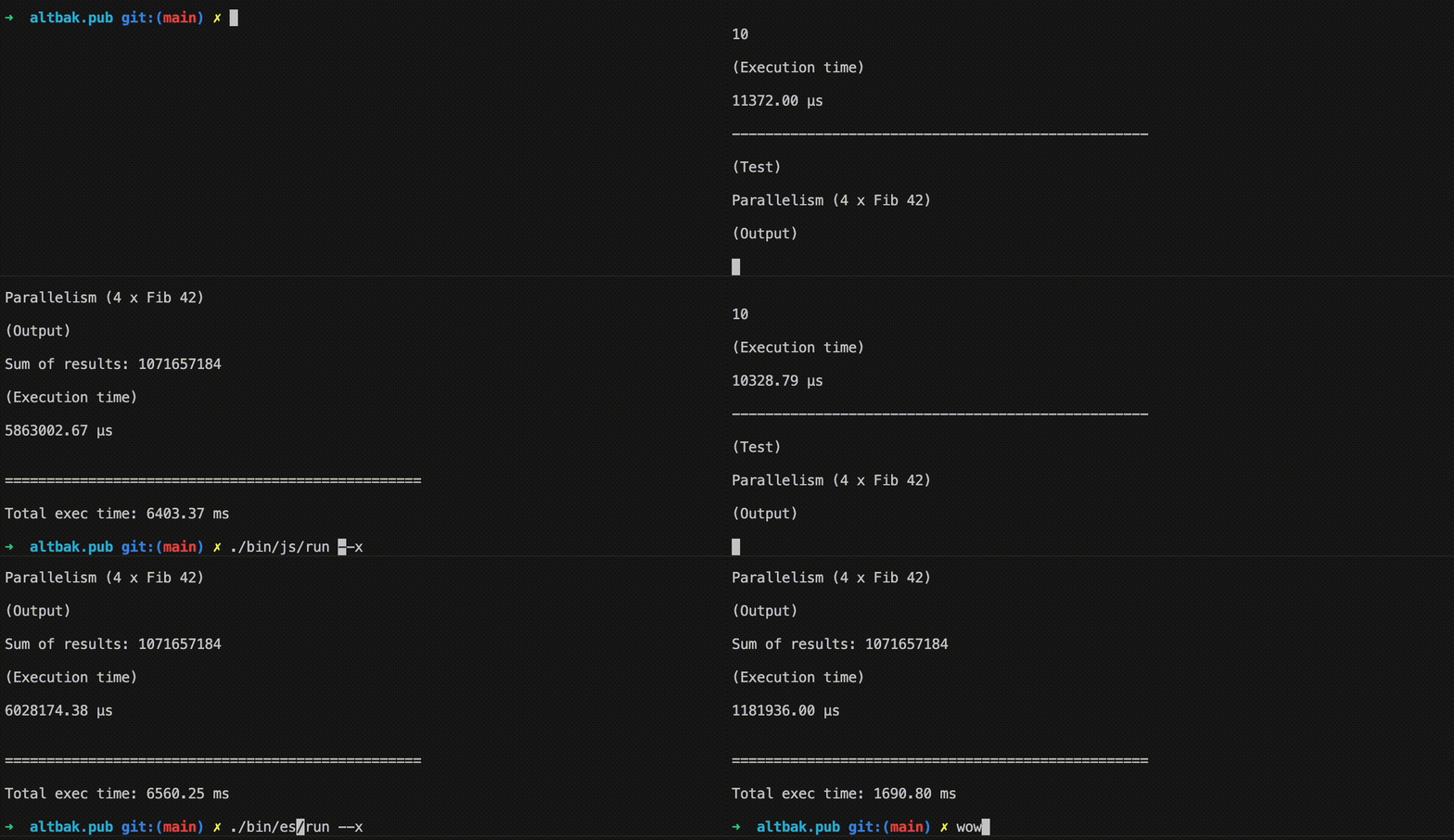
JS and Arista run Fib 42 sequentially on a single thread blocking the event loop, while Go successfully distributes the 4 heavy tasks across 4 different CPU cores, making it 4x faster for this specific workload).
Of course, the more cores you have, the wider the gap becomes. For example, testing the limits on a local machine with 10 cores (10 concurrent tasks), at home:
| Benchmark | JS (V8) | Arista ES (V8) | Go (gopurs) |
|---|---|---|---|
| Parallelism (10x Fib 42) | ~ 15113 ms | ~ 14690 ms |
~ 1255 ms
|
JS and Arista scale linearly and predictably choke, while Go devours the 10 tasks in roughly the same time it took for 4, making it ~12x faster. As you can see, Go’s performance has remained almost unchanged! There may only be a slight additional overhead due to orchestration (more children to manage).
It’s incredibly satisfying to write standard, pure PureScript code with Aff and forkAff, and get true, unboxed multi-threading entirely for free on the backend. The perf gain is awesome. This is quite similar to what TS devs have seen in their comptime with v7 (their recent game-changing major release). But here, that’s pure runtime progress.
A summary is available here.
Next step: put gopurs through its paces with integration tests (Postgres, S3, RabbitMQ…), complete the core lib FFIs (e.g. parAff), etc.
News #11:
100% green on the integration tests of b8x, but more importantly on the unit tests of Aff (gopurs-aff, mirror of purescript-aff)
Aff is one of the most complex and critical core libraries in the PureScript ecosystem. It handles asynchronous fibers, AVars, intricate error handling (bracket), cancellation, parallel execution (parAff), etc.
Getting all these tests to pass proves that the Go implementation (which relies natively on true multi-threading via goroutines and shared memory) is not just blazing fast, but semantically sound and strictly correct. We’ve successfully mapped the subtle edge cases of JS cooperative concurrency to Go’s parallel execution model without breaking the API or the expected behaviors.
To be even more precise: I found that a few original tests were actually somewhat “tainted” by the JS Event Loop conceptual model. They implicitly relied on synchronous execution happening before encountering the first blocking handler (which leaked in the assertions). In a true parallel environment like Go, where forkAff spawns an actual concurrent goroutine instantly, these hidden race conditions were immediately exposed. We had to slightly adjust those tests to be truly async-safe, which further proves the strictness and robustness of this new parallel foundation. Example: before and after.
Aff is now a pure abstraction, decoupled from the historical JS runtime.
Next steps: gopurs-arrays, gopurs-assert, etc.
